The Power of Vacations
Updated: Jul 21
Vacations are often seen as a luxury, but studies suggest that vacations are an important part of a healthy, sustainable lifestyle. Time away from work and daily demands is associated with an improvement in physical and mental health, reduction in stress, increase in creativity and productivity, and strengthening of connections or relationships. Evidence also offers clues about how long a vacation should be to gain these benefits.
Why Vacation?
Chronic work stress — especially when we don’t really recover from it — is linked with a higher risk of heart disease and even early death in men (1,2). Vacations can act like your reset button, easing the mental and physical exhaustion and burnout that build up from work (3,4), and they can also help improve sleep. People tend to feel better during time off, and that boost in well-being can last for 1 to 4 weeks after they return, especially when they truly step away from work and choose how to spend their time (5,6).
But be honest with yourself: when you go on vacation, do you actually unplug from work? Do you make yourself truly unavailable? Or do you find yourself sneaking looks at work texts and emails during the very time that’s supposed to restore you?
Taking vacations regularly is linked with less burnout, fewer symptoms of depression, and greater life satisfaction (6,7). Certain kinds of recovery experiences are especially powerful — things like mentally detaching from work, relaxing, learning or mastering something new, and feeling in control of your time (7,8). After a break, many employees report more energy, better focus, and higher engagement, while workplaces often see fewer mistakes and less absenteeism (6,7,9).
Stepping away from focused work, especially in natural or new environments, can also boost one’s creativity and problem-solving (10,11). Letting your mind wander during breaks can lead to fresh insights (9). Spending time in nature — hiking, walking on the beach, or simply sitting outside — helps restore your attention and ease mental fatigue, making it easier to concentrate and make good decisions once you’re back at work (11). Experiencing different cultures and locations is also tied to greater mental flexibility and creativity (12), and traveling to new places may build emotional agility and empathy (13).
Strong social connections are linked with lower mortality and better mental health (14). Vacations often give us longer stretches of low-pressure time with family and friends, which supports closeness, communication, and overall relationship satisfaction (15-17). Among those aged 55 and older, investigators found self-rated health was higher among those seeing family with greater frequency (18).
How to Vacation
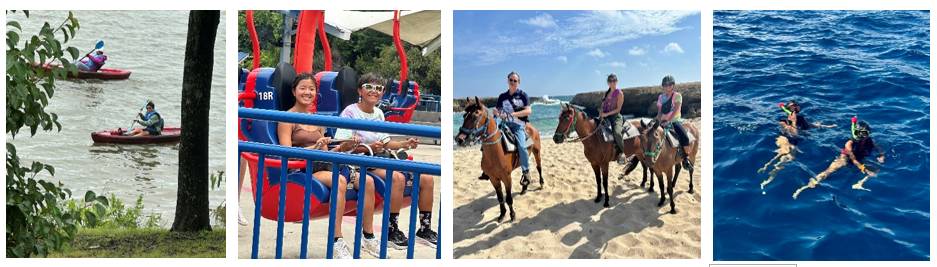
Not only are short breaks of three to four days restorative (4) but one study found that increases in health and well-being peak about day eight and persist longer among vacationers who determine how to spend their own leisure time while on vacation (5). In other words, engagement in activities of one’s own choice matters. For example, If your vacation preference is to go on a hike and campout, and mine is to sit under an umbrella or palapa on the beach listening to the waves crash to shore, we can both feel the restorative effects of our own trips because we chose those activities. Although it is true that not everyone within a family or friend unit will enjoy the same activities, you can sometimes plan options. For a day at the beach, you can pack inexpensive snorkeling gear and underwater cameras for the more active while others can bring a book or build castles in the sand. At the end of the day, everyone shares a meal and personal experiences while watching the sun kiss the horizon.
Because the health and well-being benefits wane upon return to work, multiple shorter breaks yearly are suggested instead of an extended single vacation of three or more weeks (4). Those reporting fewer barriers to taking more trips (trips greater than 15 miles from home) had higher self-rated health. If you have more than a week of vacation benefits or personal days, try using two of your vacation days to create a 4-day weekend vacation at another time of the year. For example, try snow tubing in Wisconsin or another nearby state during an extended weekend in February. Or meet up with your adult children on an autumn weekend for wine-tasting in the Finger Lakes in New York.
Even the process of planning a trip to be very satisfying. A 2020 survey found that the act of planning and booking a trip increased happiness. Michelle Gielan, Founder of the Institute for Applied Positive Research and Executive Producer of "The Happiness Advantage" on PBS, said respondents “overwhelmingly believe that anticipating a planned trip delivers significant mental health benefits” (19). Daydream for inspiration about experiences that would make your vacation memorable. What brings you joy? Horseback riding on the beach? Snorkeling off a “pirate ship”? Wine tasting in Tuscany?

Join in the planning to hunt for excursions that provide special meaning and opportunities for bonding during the trip by using detailed descriptions, itineraries, and reviews in Viator, Get Your Guide, or TripAdvisor to guide your decision. People gain more enduring satisfaction and happiness from purchasing experiences over material possession purchases (e.g., television) (20). Happiness increases endorphins during the vacation planning process, while experiencing the vacation, and when reliving the experiences through retelling and thought. Are you worried about the cost of the excursions? Be selective as needed and realize that, in comparison to material possessions, the level of enjoyment is less connected to the cost of experience (21).
Practical Guidelines for Effective Vacations
Based on current evidence, several principles can help make vacations more effective for health, creativity, and relationships:
Aim for at least one vacation of about 7–10 days per year, allowing time for full psychological detachment and recovery.
Supplement with shorter breaks (3–4 days or long weekends) throughout the year to maintain regular recovery.
Detach from work by limiting email and work-related communication. Set clear boundaries before leaving.
Prioritize sleep and relaxation.
Include meaningful, self-chosen activities.
Use anticipation and planning as part of the well-being boost.
Foster connection by spending quality time with family or friends and planning shared experiences (e.g., meals, walks, social games).
Plan re-entry, allowing a buffer day before returning to full workload to preserve gains.
So… do you really NEED a vacation? The evidence says YES you do! Vacations are not an indulgence but rather an important investment in your long-term well-being.
References
Gump BB, Matthews KA. Are vacations good for your health? The 9-year mortality experience after the Multiple Risk Factor Intervention Trial. Psychosomatic Medicine. 2000;62(5):608-612. doi:10.1097/00006842-200009000-00003
Strandberg TE, Strandberg AY, Pitkälä K, Salomaa VV, Tilvis RS, Miettinen TA. The effect of midlife vacation on health in old age: the Helsinki Businessmen Study. Journal of Nutrition, Health & Aging. 2017;21(1):79-84. doi:10.1007/s12603-016-0740-4
Gill, C., Packer, J., & Ballantyne, R. Spiritual retreats as a restorative destination: Design factors facilitating restorative outcomes. Annals of Tourism Research. 2019; 79 (Article 102761).
Packer, J. Taking a break: Exploring the restorative benefits of short breaks and vacations. Annals of Tourism Research Empirical Insights. 2021; 2,100006. http://dx.doi.org/10.1016/j.annale.2020.100006
de Bloom J, Geurts SAE, Kompier MAJ. Vacation (after-) effects on employee health and well-being, and the role of vacation activities, experiences and sleep. Journal of Happiness Studies. 2013;14(2):613-633. doi:10.1007/s10902-012-9345-3
de Bloom J, Geurts SAE, Sonnentag S, Taris T, Kompier MAJ. Effects of vacation from work on health and well-being: lots of fun, quickly gone. Work & Stress. 2010;24(2):196-216. doi:10.1080/02678373.2010.493385
Westman M, Etzion D. The impact of vacation and job stress on burnout and absenteeism. Psychology & Health. 2001;16(5):595-606. doi:10.1080/08870440108405529
de Bloom J, Geurts SAE, Kompier MAJ, et al. Do we recover from vacation? Meta-analysis of vacation effects on health and well-being. Journal of Occupational Health. 2009;51(1):13-25. doi:10.1539/joh.L8004
Sonnentag S, Fritz C. Recovery from job stress: the stressor-detachment model as an integrative framework. Journal of Organizational Behavior. 2015;36(suppl 1):S72-S103. doi:10.1002/job.1924
Baird B, Smallwood J, Mrazek MD, Kam JWY, Franklin MS, Schooler JW. Inspired by distraction: mind wandering facilitates creative incubation. Psychological Science. 2012;23(10):1117-1122. doi:10.1177/0956797612446024
Berman MG, Jonides J, Kaplan S. The cognitive benefits of interacting with nature. Psychological Science. 2008;19(12):1207-1212. doi:10.1111/j.1467-9280.2008.02225.x
Maddux WW, Galinsky AD. Cultural borders and mental barriers: the relationship between living abroad and creativity. Journal of Personality and Social Psychology. 2009;96(5):1047-1061. doi:10.1037/a0014861
Kashdan TB. The mental benefits of vacationing somewhere new. Harvard Business Review. Published January 26, 2018. Accessed [date]. https://hbr.org/2018/01/the-mental-benefits-of-vacationing-somewhere-new
Holt-Lunstad J, Smith TB, Layton JB. Social relationships and mortality risk: a meta-analytic review. PLOS Medicine. 2010;7(7):e1000316. doi:10.1371/journal.pmed.1000316
Lehto XY, Choi S, Lin YC, MacDermid SM. Vacation and family functioning. Annals of Tourism Research. 2009;36(3):459-479. doi:10.1016/j.annals.2009.04.003
Zabriskie RB, McCormick BP. Parent and child perspectives of family leisure involvement and satisfaction with family life. Journal of Leisure Research. 2003;35(2):163-189. doi:10.1080/00222216.2003.11949989
Kono S, Walker GJ, Ishii K, Hagi Y. Examining relationships between family leisure and family functioning among Japanese families. Annals of Leisure Research. 2015;18(2):177-193. doi:10.1080/11745398.2014.938154
Anciaes P, Metcalfe P. Constraints to travel outside the local area: Effect on social participation and self-rated health. Journal of Transport and Health. 2023; 28: 101535.
Gielan M. Planning Travel Creates Happiness. Institute for Applied Positive Research. https://www.ustravel.org/sites/default/files/media_root/document/PlanningTravel_MichelleGielan.pdf
Carter T, Gilovich T. The relative relativity of material and experiential purchases. Journal of Personality and Social Psychology. 2020; 98(1):146-59. Doi: 10.1037/a0017145
Carter TJ, Gilovich T. Getting the most for the money: The hedonic return on experiential and materials purchases. In M. Tazel (Ed.), Consumption and well-being in the material world (pp.49-62). Springer Science + Business Media. 2014. https://doi.org/10.1007/978-94-007-7368-4_3
Feel free to email me feedback using the link in the page footer.